

This Test At A Glance
This cheek swab reads both copies of your APOE genes and reports the pair you were born with. Some pairs lower your risk of Alzheimer’s disease and some raise it. E4/E4 combination carries the highest risk of the six, and E2 pairs the lowest.
The same gene helps your body clear cholesterol, so one test tells you something about your heart and your memory at the same time. If your result comes back on the higher-risk side, it gives you a strong reason to work on improving your health now instead of years from now. What it cannot tell you is whether you will get the disease.
Order this if Alzheimer’s disease or dementia runs in your family, or your cholesterol and triglycerides both run high and no one has explained why.
Your result matters to your family. You pass one copy to each child, so your grown children may carry a different pair than you do. Adults in a family sometimes test together, since knowing early gives everyone more years to build habits that protect the heart and brain.
Hold off if you are not sure you want the answer. You cannot unlearn your test results. Consulting with a genetic counselor may be helpful.
What the APOE Gene Test Measures
You have two copies of the APOE gene. One came from your mother, one from your father. Each copy is an E2, an E3, or an E4.
The APOE test looks at both copies and reports the pair you have. There are only six possible answers:
- E2 / E2
- E2 / E3
- E2 / E4
- E3 / E3
- E3 / E4
- E4 / E4
E3 is the version most people carry. APOE4 is the one linked to higher Alzheimer’s risk and higher cholesterol, and it is the version most people are looking for when they order this test. E2 is the least common, and it generally protects against Alzheimer’s disease, though it comes with a cholesterol catch covered further down this page.
This test does not look at your brain or measure anything happening in your body today. It reports genes you were born with, which is why your APOE test results will look the same for life.
How the Cheek Swab Collection Works
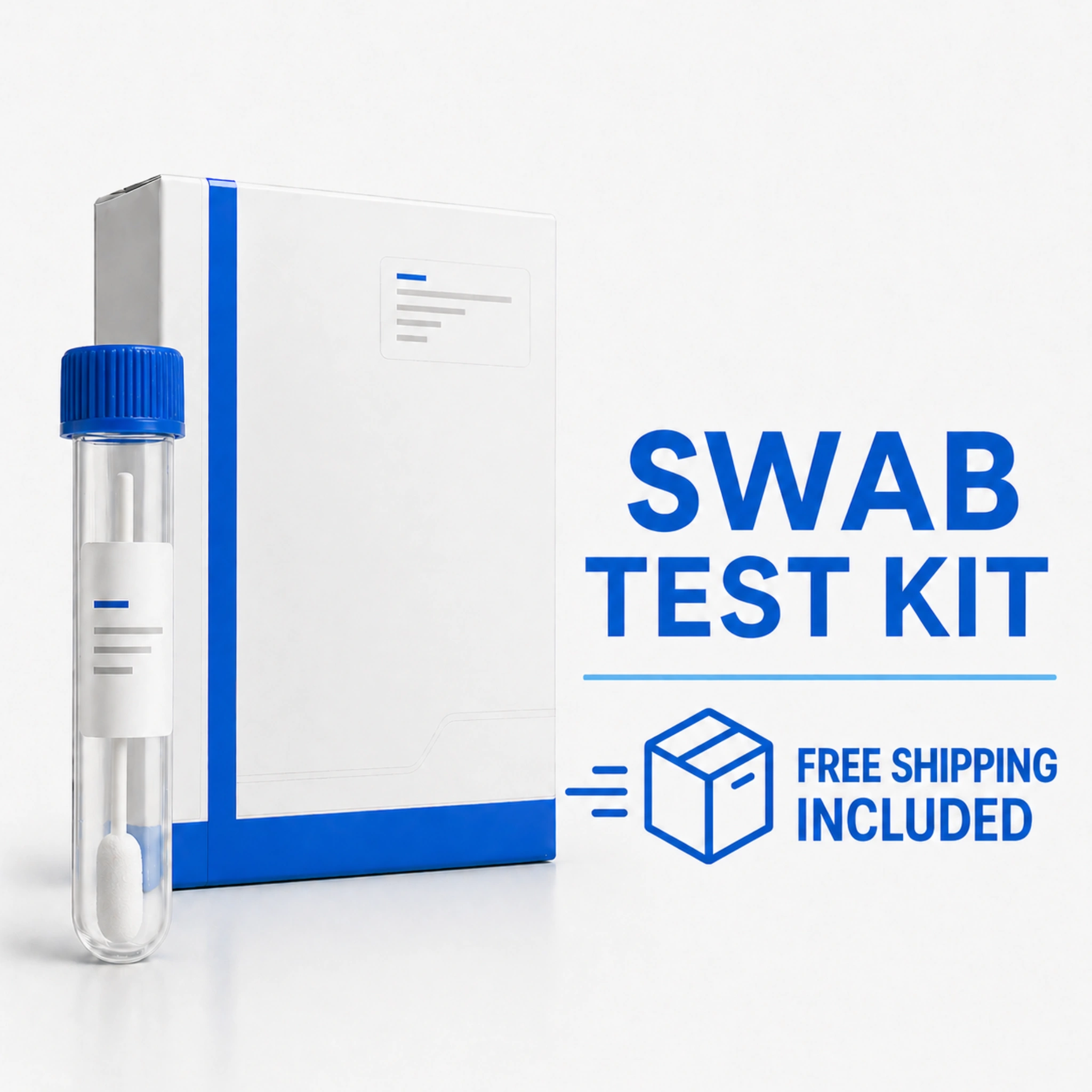
The kit comes to your house. You rub the swab firmly against the inside of your cheek, seal it in the return envelope, and put it in the mail. No fasting, no needle, no appointment.
Why One Gene Affects Both Memory and Cholesterol
APOE builds a protein that works like a handle. Fat and cholesterol cannot move through your blood on their own, so your body wraps them into little packages and sticks these handles on the outside. Your liver grabs a handle and pulls the package out of your blood.
E2, E3, and E4 each build a slightly different handle. Some grip well and some do not. That is the whole reason this gene shows up in your cholesterol results.
Your brain uses the same protein for a different job, helping cycle cholesterol (what your brain is mostly made up of) in and out of brain cells, and that is where the Alzheimer’s connection comes from.
How Cholesterol in the Brain Connects to Alzheimer’s Risk
Your brain runs on cholesterol. Brain cells use it to build and repair the coating around their connections, and that material has to be moved from cell to cell constantly. APOE is the delivery system that moves it.
Here is where the versions differ. E2 particles carry a full load of fat and cholesterol and hand it off well. APOE4 particles carry less and do the job poorly.
The same delivery system also helps sweep amyloid out of the brain, the sticky protein that builds up in Alzheimer’s disease. So the version that moves cholesterol well tends to clear amyloid well, and the version that struggles with one struggles with both. That is the simplest explanation researchers have for why E2 pairs sit at the low end of the risk table and APOE4 pairs sit at the high end.
It is worth being precise about what this does and does not mean. E2 lowers Alzheimer’s risk specifically. It is not a blanket protection for the brain, and E2 carriers have somewhat higher rates of certain other brain and blood vessel problems.
What Each APOE Result Means for Alzheimer’s Risk
Most people have E3/E3, so that is what researchers compare everyone else to. Find your pair below.
These numbers come from studies of large groups of people. They shift somewhat depending on who was studied.
What “3 to 4 Times Higher” Really Means
Three times higher sounds alarming until you know what it is three times bigger than. So here is the starting point.
Out of 100 people, about 12 develop Alzheimer’s disease by age 85. That is where an E3/E3 result sits. With one APOE4 copy, that number moves to around 22 out of 100. With two copies, it climbs to roughly 60 out of 100.
Now flip those numbers over. With one copy, about 78 out of 100 people never get the disease. Even with two copies, about 40 out of 100 do not. Your age, your sex, your family history, and your blood pressure all shift where you land.
Why APOE4 Shows Up More Often in Some Families
About 1 in 4 people carry at least one APOE4 copy, but it is not spread evenly. Some family backgrounds carry it more often than others. That is part of why Alzheimer’s disease can seem to run through every branch of a family tree.
How much APOE4 raises risk also varies. The increase measured in Black and Hispanic families has generally come out smaller than the increase measured in white families, where most of this research was done. If your background is not mainly European, the numbers above probably run high for you.
What Each APOE Result Means for Cholesterol and Heart Health
People tend to skip this half of the result. It is often the more useful half, because cholesterol is something you can do something about.
LDL Is Not “Bad” Cholesterol
LDL is a delivery truck, and the cargo is something your body needs. Your cells use that cholesterol to build their outer walls, make hormones, produce vitamin D, and repair themselves. The problem was never the cargo. It is having too many trucks on the road, trucks small enough to slip into artery walls, and artery walls already inflamed enough to trap them, and a basic cholesterol panel measures none of that.
Your Genes Show a Tendency, Not Your Actual Risk
Everything in the table below is a tendency. Your APOE result says which direction your body leans, not where your numbers sit today. Two people with the same result can have completely different cholesterol, because diet, weight, activity, thyroid function, blood sugar, and other genes all pull on it.
So use the table to know what to watch for, then go measure it.
See what your cholesterol is actually doing
A routine panel gives you one LDL number. The Cardio IQ Advanced Cholesterol Panel measures ApoB, particle size and density, Lp(a), hs-CRP, and Lp-PLA2, the markers that explain why two people with identical LDL can have very different risk.
The colors above are about cholesterol only. They do not match the Alzheimer’s table, and E2/E2 shows you why.
Reasons People Order This Test
- Alzheimer’s disease or dementia in the family. Watching a parent go through it raises a question you cannot put down. This is the part of it you can actually measure.
- High cholesterol and triglycerides no one can explain. The E2/E2 pattern is a known cause that often goes unconsidered for years.
- Wanting a reason to act while it still counts. Controlling blood pressure and staying active seem to help the brain most when you start in your forties and fifties.
- Deciding how hard to treat heart risk. An APOE4 result is one more reason to look closely at cholesterol now instead of watching it climb.
- Already checking brain markers. This test tells you what you inherited. Blood markers tell you what is happening now. People often run both.
Think About How You Will Take the News
Some people find an APOE4 answer clears things up. It turns a worry they cannot name into something specific, and it gives them a reason to finally deal with blood pressure, sleep, exercise, and cholesterol.
Other people find it heavy to carry, especially when nothing about their medical care would change either way. Both reactions make sense.
Your result also says something about your brothers, sisters, and grown children, since you share genes with them. Some families would rather talk it over before anyone swabs.
One practical note. Federal law limits how health insurers and employers can use genetic results, but that protection does not cover life insurance, long-term care insurance, or disability insurance in most states. Genetic counselors talk people through this every day, and calling one first is a normal step, not an overcautious one.
Tests People Order Alongside This One
This test reads what you were born with, which never changes. The tests below measure what is happening in your body now, which does.
Cardio IQ Advanced Cholesterol Panel with Inflammation, Size and Density
The follow-up for the cholesterol half of your result. Measures particle size and number, ApoB, Lp(a), and two inflammation markers that a routine panel leaves out.
Phosphorylated Tau 217 (p-tau217) Blood Test
Measures a protein in your blood that rises as Alzheimer’s-related changes build in the brain. The most talked-about blood marker right now.
Beta-Amyloid 42/40 Ratio Blood Test
Compares two forms of amyloid in your blood. A low ratio can mean amyloid is collecting in the brain instead of clearing out.
Alzheimer’s-Associated Immune Reactivity (Alzheimer’s LINX)
Checks whether your immune system is reacting to proteins found in the brain and nervous system.
APOE Gene Test: Common Questions
Does an APOE4 result mean I have Alzheimer’s disease?
No. APOE4 raises your odds and nothing more. Plenty of people carry one or two copies and never get the disease. About 4 out of 10 people who do get it carry no APOE4 copy at all. Diagnosing Alzheimer’s takes a full workup by a doctor.
If I carry APOE4, is there anything I can do?
You cannot change the gene, but it is one piece of a bigger picture. Controlling blood pressure, staying active, sleeping well, treating hearing loss, not smoking, managing diabetes, and keeping cholesterol in range are all tied to dementia risk in large studies. Starting early is where the benefit seems to be.
My parent has Alzheimer’s disease. Does that mean I will get it?
No. Having a parent with the disease raises your risk, but late-onset Alzheimer’s is not handed down in a predictable way like some conditions are. APOE is part of what gets passed along, which is why testing can turn a vague family worry into a real number. There are rare early-onset forms that do run in families more directly, and those involve different genes than this test reads.
Should my children get tested too?
You pass one of your two copies to each child, so their pair can differ from yours and from each other’s. For grown children, testing can be worth it, since knowing early gives them more years to build habits that protect the heart and brain. For children under 18, testing is generally not recommended for a condition that shows up in old age, and most doctors and genetic counselors suggest waiting until they are adults and can decide for themselves.
How accurate is a cheek swab compared to blood?
Just as accurate. Every cell in your body carries the same DNA, so a cheek sample gives the same answer blood would. Genova Diagnostics runs the analysis in a CLIA-certified lab with standard quality checks. In the lab’s own materials, accuracy is listed as less than 100 percent without giving a specific number. In practice, what goes wrong is not a wrong answer but a sample too thin to read, which means swabbing again.
Do I need a doctor’s order, and is there a collection site near me?
No order needed. True Health Labs includes physician authorization. You also do not need a collection site, since the kit comes to your home and you collect the sample yourself. If you are also ordering a test that needs blood, you can look up nearby draw centers.
How long do results take, and what does the test cost?
Usually 7 to 14 business days once the lab has your kit, plus mailing time each way. The price is at the top of this page and includes shipping. There is no blood draw fee, because there is no blood draw.
Will I ever need to take it again?
No. Your APOE result was set before you were born and stays the same for life. The only reason to swab again is if the lab could not read your first sample.
Can someone help me understand my result?
Your doctor should read it alongside your family history, cholesterol numbers, blood pressure, and any memory concerns you have. True Health Labs also offers an educational One-On-One Results Review, which walks you through what you are looking at. It does not replace advice from your own doctor.
Medical Review Board
Reviewed by Jeff Donohue M.D. from Body Logic and Brady Hurst DC, CCCN. Written by True Health Lab’s team of editorial health contributors.
Disclaimer: This information is for educational purposes only and not intended as medical advice. Consult your healthcare provider for personalized guidance.
Why Customers Trust True Health Labs – What People are saying


Also rated 4.6 out of 5 based on 3452 ShopperApproved reviews- See all TrueHealthLabs.com reviews.